Dollar-Cost Averaging Explained: A Beginner's Guide to Investing a Little at a Time
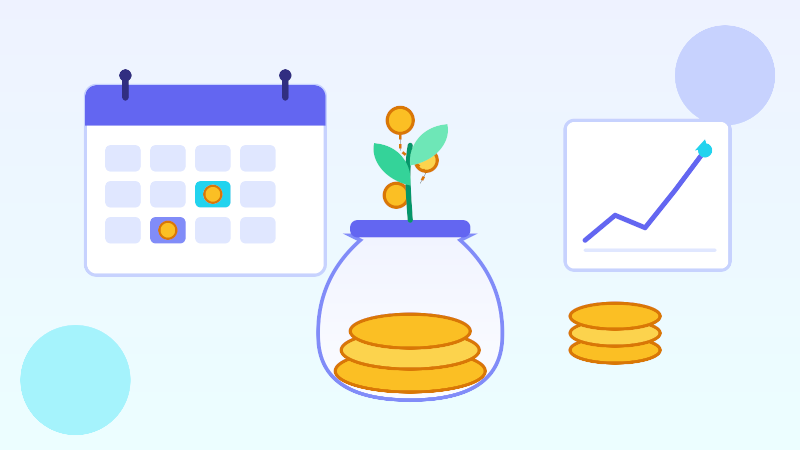
You do not need a lot of money or perfect timing to start investing. Dollar-cost averaging is the simple habit behind many long-term portfolios, and anyone can use it.
What is dollar-cost averaging?
Dollar-cost averaging means investing your money in equal portions, at regular intervals, regardless of the ups and downs in the market. That is the definition from Investor.gov, the US government's investor education site.
Because your amount stays fixed, your money automatically buys more shares when prices are low and fewer shares when prices are high. You never have to guess whether today is a good day to invest.
A simple example
Imagine you invest $100 on the first of every month into one fund. These numbers are made up, just to show the math:
- Month 1: the price is $10, so your $100 buys 10 shares.
- Month 2: the price drops to $8, so your $100 buys 12.5 shares.
- Month 3: the price rises to $12.50, so your $100 buys 8 shares.
You spent $300 and now own 30.5 shares. Your average cost per share is about $9.84, even though the average price over those three months was about $10.17. The dips worked in your favor because you kept buying on schedule.
Why beginners like it
- It turns investing into a habit instead of a decision you remake every month.
- It removes the stress of trying to time the market, which even professionals get wrong.
- It works with small amounts. Many brokers allow fractional shares, so $25 or $50 a month is enough to start.
- It pairs naturally with automatic transfers, so the habit runs itself.
What it does not do
Dollar-cost averaging is not magic, and it is fair to know its limits before you start:
- If the market keeps falling for years, your investments can lose value the whole time. Regular buying does not protect you from a bad investment.
- If you already have a large lump sum and markets rise steadily, investing it all at once has often come out ahead historically. Charles Schwab's research discusses this tradeoff openly.
- It does not remove risk. It only removes the timing guesswork.
How to start
- Pick one low-cost, broadly diversified fund, such as an index fund or ETF, instead of betting on a single company.
- Choose a fixed amount you can repeat every month without stress.
- Set up an automatic monthly purchase so you never skip it.
- Check in once or twice a year. Daily watching only adds anxiety.
The honest risks
Markets can fall and stay down longer than you expect, and you can lose money, including money you needed. Past patterns do not guarantee future results. This article is general education, not personal financial advice, and it cannot know your situation. If you are making big decisions, talk to a licensed financial advisor first.
If you take one thing away: a small, automatic, boring habit beats a perfect plan you never start.
Comments
Post a Comment